
Quick answer: in the United States, money a blog earns is taxable income, whether it arrives as ad revenue, affiliate commissions, sponsored post fees or products received in exchange for content. Most beginner bloggers report it on Schedule C with their Form 1040 tax return, owe self-employment tax once net earnings reach $400 for the year, and may need to pay quarterly estimated taxes on top of regular income tax. The single most useful habit is tracking every payment and every expense from day one, with the date, source, amount and a receipt.
Taxes are rarely why anyone starts a blog, and they are easy to ignore when the first ad payment is small. That is exactly when a simple system pays off. Records kept as you go make filing faster, help you claim legitimate expenses and protect you if the IRS ever asks questions.
This guide covers the basics a new US blogger needs: what counts as income, the forms you might receive, self-employment tax, quarterly payments, deductible expenses and how to keep records without spending a weekend on it. It is one piece of our guide on how to start a blog that makes money, which walks through setup, content and monetization. Tax rules change and individual situations vary, so treat this as general education, not tax advice, and confirm details with the IRS or a qualified tax professional.

Is Blog Income Taxable?
Yes. The IRS taxes income from any source unless the law specifically excludes it, and nothing excludes blogging. Income does not become taxable only when a company sends a form; it is taxable when you receive it.
Common types of blog income
- Display ad revenue from networks such as Google AdSense, Mediavine, Raptive or Ezoic. Our explainer on how blog ad networks work covers how those payments are calculated.
- Affiliate commissions from retailers and affiliate networks.
- Sponsored posts, brand partnerships and paid social posts connected to the blog.
- Sales of your own digital products, courses, templates or printables.
- Memberships, paid newsletters and reader support.
- Freelance work that comes to you through the blog, such as writing or consulting.
Free products count too
Bloggers often receive products from brands. The IRS explains in its guidance on bartering (Tax Topic 420) that the fair market value of goods or services received in exchange for your services is taxable income. A product sent on the condition that you review it or post about it can fall into that category. Unsolicited items with no obligation are a grayer area, so keep a note of what you received and why, and ask a tax professional how to treat it.

How Blog Profit Is Taxed: Income Tax, FICA and Your Tax Bracket
Blog profit is hit by two federal taxes at once. Knowing how they stack helps you set money aside and spot the tax deductions that matter.
Federal income tax and your bracket
Your blog profit is added to any wages and other income, and federal income tax is figured on the total after deductions. The rates are marginal, so only the income inside each bracket is taxed at that bracket’s rate. For tax year 2026 (returns filed in 2027), the Internal Revenue Service lists a 10% rate on taxable income up to $12,400 for single filers ($24,800 for married couples filing jointly), 12% above that, and 22% on taxable income over $50,400 single ($100,800 joint), with higher brackets above those levels. A blogger with a full-time job often finds that every blog dollar lands in the same bracket as the last dollars of salary.
FICA taxes and self-employment tax
Employees split FICA taxes (Social Security and Medicare) with their employer through payroll. Self-employed people pay both halves through self-employment tax, covered in detail below. For 2026, the Social Security part applies only to combined wages and self-employment earnings up to $184,500, while Medicare tax has no cap, according to IRS Publication 15. An Additional Medicare Tax of 0.9% also applies to earnings above $200,000 for single filers or $250,000 for married couples filing jointly.
Standard deduction or itemized deductions
Every filer chooses between the standard deduction and itemized deductions such as mortgage interest, state and local taxes and charitable gifts. For tax year 2026, the IRS sets the standard deduction at $16,100 for single filers, $32,200 for married couples filing jointly and $24,150 for heads of household. Most people take the standard deduction. Either way, it is separate from your blog’s business expenses, which are deducted on Schedule C before income tax is figured, so you claim business expenses even if you never itemize.
The qualified business income deduction
Many sole proprietors can also take the qualified business income (QBI) deduction under Section 199A, worth up to 20% of qualified business income, claimed on Form 8995 or Form 8995-A. The IRS notes that the 2025 tax law, which it calls the Working Families Tax Cuts (also known as the One, Big, Beautiful Bill), made the deduction permanent. Limits apply at higher income levels, and the deduction reduces income tax but not self-employment tax.
Tax deductions vs tax credits
A tax deduction lowers the income your tax is calculated on, so its value depends on your bracket. A tax credit lowers your tax liability dollar for dollar, which makes a credit worth more than a deduction of the same size. Most blog-related savings come from deductions; tax credits for small bloggers are less common, though some general credits, such as the Earned Income Tax Credit, count self-employment earnings when figuring eligibility.

The Tax Forms Bloggers Commonly See
Payers send information returns to you and to the IRS. These forms are a cross-check, not the definition of what you owe; you must report all income even if no form arrives.
Form 1099-NEC
Businesses use Form 1099-NEC to report nonemployee compensation, such as fees paid to a freelancer or a blogger for services. According to the IRS instructions for 2026, the reporting threshold is $2,000 or more paid to a non-employee during the year, up from the long-standing $600 threshold that applied through 2025.
Form 1099-MISC
Some programs report certain payments, such as royalties or other income, on Form 1099-MISC instead. Which form a company uses depends on the type of payment, so do not be surprised if one affiliate program sends a 1099-NEC and another sends a 1099-MISC.
Form 1099-K
Payment platforms and marketplaces (third-party settlement organizations) report payments on Form 1099-K. The IRS says these organizations must file one when a payee receives more than $20,000 in gross payments and more than 200 transactions in a calendar year, though a platform may still send one below those levels. Selling digital products through a payment processor is a common reason bloggers receive this form.
Tax forms from overseas companies
Some ad networks and platforms are based outside the US and handle tax paperwork differently, often asking you to complete a Form W-9 to confirm you are a US person. Keep copies of any tax forms you submit to platforms.

Self-Employment Tax and Quarterly Estimates
Self-employment tax
Most bloggers are self-employed in the eyes of the IRS, even with a full-time job elsewhere. The IRS says you must pay self-employment tax and file Schedule SE if your net earnings from self-employment are $400 or more. The rate is 15.3 percent: 12.4 percent for Social Security and 2.9 percent for Medicare tax, applied to net earnings rather than gross income. Schedule SE figures the tax on 92.35 percent of net earnings. You can deduct the employer-equivalent portion of self-employment tax when figuring adjusted gross income.
Self-employment tax is separate from regular income tax. New bloggers are often surprised that a modest profit still creates a bill, because no employer has been withholding anything.
Quarterly estimated taxes
The IRS expects tax to be paid as income is earned, which is why estimated payments are often called quarterly taxes. It says individuals, including sole proprietors, generally need to make estimated tax payments if they expect to owe $1,000 or more when they file. The year is split into four payment periods; under Publication 505, payments are generally due around April 15, June 15, September 15 and January 15 of the following year, moving to the next business day when a date falls on a weekend or holiday.
Payments can be made online, by phone, through the IRS app or by mail with Form 1040-ES. The IRS also allows more frequent payments, such as monthly, as long as enough has been paid by the end of each period.
Avoiding the underpayment penalty
The IRS says most taxpayers avoid the underpayment penalty if they owe less than $1,000 after withholding and credits, or if they paid at least 90 percent of the current year’s tax or 100 percent of the prior year’s tax, whichever is smaller (higher-income taxpayers have a stricter rule). If you also have a job, another option is asking your employer to withhold more by filing a new Form W-4, which the IRS lists as a way to avoid estimated payments altogether.

Blogging Expenses Worth Tracking
Business expenses reduce the profit that both income tax and self-employment tax are calculated on. The IRS standard is that a business expense must be ordinary (common in your field) and necessary (helpful and appropriate). Personal costs do not qualify, and items used for both need to be split by business-use percentage.
Typical blogging expenses
- Web hosting, domain names and premium themes or plugins. Our comparison of WordPress hosting for new bloggers explains what you are paying for.
- Software subscriptions such as SEO tools, email marketing services, design apps and AI writing or image tools used for the blog.
- Stock photos, fonts and other licensed assets.
- Freelance help, such as editors, designers, virtual assistants or developers.
- Equipment such as a camera, microphone or lighting, in proportion to business use.
- Internet and phone service, in proportion to business use.
- Courses and books that improve skills used in the blog.
- Advertising and promotion, such as paid social or Pinterest ads.
- Bank and payment processing fees.
The home office deduction
If part of your home is used regularly and exclusively for the business and is your principal place of business, you may qualify for the home office deduction. The IRS simplified method allows $5 per square foot of qualifying space, up to 300 square feet, for a maximum of $1,500. A kitchen table you also eat at does not meet the exclusive-use test. IRS Publication 587 explains both the simplified and regular methods.
What usually does not qualify
Clothing you could wear outside of content, personal travel that happens to include a blog post, and products bought mainly for your own use are common problem areas. If an expense would exist without the blog, be cautious.
Equipment Purchases: Section 179, Bonus Depreciation and the De Minimis Rule
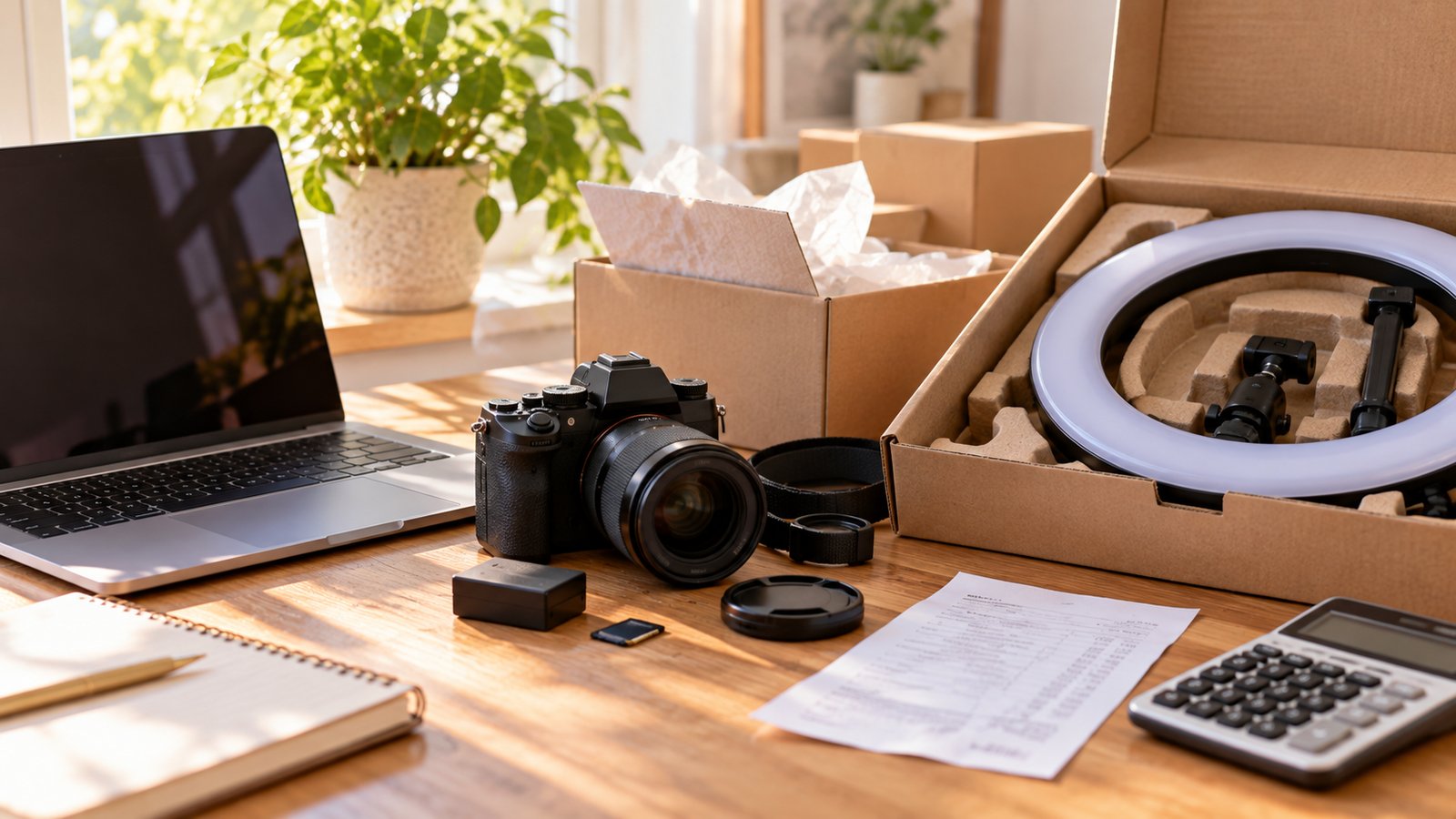
A camera, laptop or microphone usually lasts more than a year, so the tax rules treat it differently from a monthly software bill. In general, business property is depreciated, meaning its cost is deducted over several years. Three provisions often let small bloggers deduct the cost sooner.
The de minimis safe harbor
Under the IRS tangible property rules, a business without audited financial statements can elect to deduct items costing up to $2,500 each (per invoice or per item) in the year of purchase instead of depreciating them. Many blog purchases, such as a microphone or a ring light, fall under that amount. The election is made each year by attaching a statement to a timely filed tax return.
Section 179
Section 179 lets you elect to deduct the cost of qualifying equipment in the year you place it in service. For tax years beginning in 2026, Rev. Proc. 2025-32 and IRS Publication 946 set the maximum Section 179 deduction at $2,560,000, reduced once total qualifying purchases pass $4,090,000, limits far above what a small blog will reach. The deduction cannot exceed your business income for the year, and property used for both business and personal purposes qualifies only if business use is more than 50 percent.
Bonus depreciation
According to IRS news release IR-2026-06 and Notice 2026-11, the One, Big, Beautiful Bill provides a permanent 100 percent additional first-year depreciation deduction, often called bonus depreciation, for qualified property acquired after January 19, 2025. Like Section 179, it allows a full first-year deduction, and Publication 946 explains the election not to claim it. IRS Publication 946 explains how the two interact and how to report them on Form 4562.
Mixed-use equipment
If you use a laptop 60 percent for the blog and 40 percent personally, only the business share is deductible. Keep a simple log of business use, because the IRS can ask you to support the percentage. If business use of Section 179 property later drops to 50 percent or less, Publication 946 explains that part of the earlier deduction may have to be added back to income.
A Simple Record-Keeping System
The IRS, in Publication 583, expects businesses to keep records that support income and deductions. It generally advises keeping tax records for three years from the date you file, with longer periods in some situations, such as records for property you still own.
Set it up once
- Open a separate checking account, and ideally a separate card, for the blog. Keeping personal and blog spending apart makes every later step easier.
- Create a simple spreadsheet with columns for date, payer or vendor, category, amount, payment method and a link to the receipt. Accounting apps work too.
- Make a digital folder for each tax year with subfolders for income statements, receipts and tax forms.
Keep it up monthly
- Download payment reports from each ad network, affiliate program and payment platform.
- Match each payout to a deposit in your blog account.
- Save receipts for every expense, and note the business purpose for anything that might look personal.
- Log products received from brands with the date, brand, item and approximate value.
Reconcile once a year
Before tax season, compare your own totals with any 1099 forms you receive. Differences are common, because some payers report gross amounts or the timing of payments crosses the year boundary. Your records are what let you explain the gap.
Good records also make it easier to see which income streams are worth your time, a point covered in our guide to affiliate marketing for blogs, where tracking each program’s results is part of the routine.

Hobby or Business: Why It Matters
The IRS distinguishes between activities carried on for profit and hobbies. Hobby income still has to be reported, but hobby expenses generally cannot be deducted under current rules, which can make a hobby more expensive at tax time than a business.
The IRS looks at a list of factors, including whether you carry on the activity in a businesslike manner, the time and effort you put in, whether you depend on the income, whether losses are due to circumstances beyond your control, whether you have changed methods to improve profitability, your expertise and whether you have made a profit in similar activities. No single factor decides it.
For a blogger, acting like a business means keeping separate records and accounts, having a plan for earning income, tracking results and adjusting your approach. A blog with no monetization and no intent to earn is more likely to look like a hobby.

Filing Your Tax Return: Form 1040, Schedule C and the Tax Deadline
When tax season arrives, a typical sole-proprietor blogger files these pieces together:
- Form 1040, the individual tax return that reports all your income.
- Schedule C, which reports blog income and business expenses and arrives at your net profit.
- Schedule SE, which figures self-employment tax on that profit.
- Form 8995 or 8995-A, if you take the qualified business income deduction.
The tax deadline
Returns for tax year 2026 are generally due April 15, 2027, which is also the deadline for any balance owed and the date of the first 2027 estimated payment. Filing Form 4868 gives an automatic six-month extension to file, but the IRS is clear that an extension of time to file is not an extension of time to pay. Interest and penalties can apply to tax not paid by the April due date.
Gig workers and small business owners
The IRS treats bloggers much like other gig workers and self-employed small business owners. Its Gig Economy Tax Center and Small Business and Self-Employed Tax Center explain record-keeping, estimated payments and forms in plain language, and they are the best free places to check a rule before you file taxes.
Tax preparation options
Simple returns can be filed with consumer tax software or IRS Free File, which offers free guided software to taxpayers under an income limit set each year. If your blog has inventory, employees, several states or a business entity, paid tax preparation from an enrolled agent, CPA or attorney is often worth the fee, and that fee is itself a deductible business expense for the Schedule C portion.
State income tax and sales tax
Most states also tax income, and some cities do too, so your blog profit may appear on a state return as well. Sales tax is separate: states, not the IRS, decide whether digital products such as printables, templates or courses are taxable, and the rules differ widely. Check your state revenue department’s guidance before you start selling products from the blog, and track sales by state from the start.

Tax Planning Through the Year
Good tax planning is mostly about avoiding surprises. A simple tax strategy for a new blog fits on a sticky note:
- Move a fixed share of every blog payout into a separate savings account for taxes, based on last year’s return or a rough estimate of your bracket plus self-employment tax.
- Check your year-to-date profit every quarter and adjust the next estimated payment up or down.
- Time large equipment purchases sensibly. Buy what the blog genuinely needs, keeping in mind that an expense paid in December counts for this year and one paid in January counts for next year.
- Review your tax obligations each fall, before the final estimated payment, so there is time to raise withholding at a day job or make a larger January payment.
- Keep the year’s paperwork in one folder so tax preparation takes an afternoon rather than a week.
Small business owners who plan this way rarely face a large, unexpected tax bill in April.

Other Tax Situations Bloggers Run Into
Most new blogs never get complicated, but a few situations come up often enough to know about.
Hiring help: contractors vs payroll tax
Paying a freelance editor or designer usually means working with an independent contractor, and you may need to send them a Form 1099-NEC if you pay $2,000 or more in 2026. Hiring an employee is different: you take on payroll tax duties, including withholding income tax and the employee’s share of Social Security and Medicare tax, paying the employer’s share and filing employment tax returns. IRS Publication 15 covers those duties, and the IRS worker classification guidance explains how to tell the two apart.
Selling a blog and capital gains
Blogs and websites are sometimes sold. IRS Publication 544 explains that the sale of a business is generally treated as a sale of its individual assets, so part of the price may be taxed as capital gains and part as ordinary income, depending on what is sold. A sale is a good moment to involve a tax professional.
LLCs, partnerships and Schedule K-1
A single-member LLC is generally taxed like a sole proprietorship and stays on Schedule C. If you run a blog with a partner through a multi-member LLC or partnership, or elect S corporation status, the business files its own return and each owner receives a Schedule K-1 showing their share of income, which then flows onto their personal tax return.
Schedule E, Schedule A and other schedules
Not every payment belongs on Schedule C. The IRS instructions for Schedule E say royalties go there, unless you are in business as a self-employed writer, artist or creator, in which case royalty income and expenses belong on Schedule C. Schedule A is only for itemized deductions such as mortgage interest and charitable gifts, never for blog expenses.
Health savings accounts and health insurance
Self-employed bloggers covered by a high-deductible health plan may be able to contribute to a health savings account (HSA) and deduct contributions on Form 8889 even without itemizing. For 2026, Rev. Proc. 2025-19 sets the limits at $4,400 for self-only coverage and $8,750 for family coverage. Separately, eligible self-employed people can deduct health insurance premiums as an adjustment to income using Form 7206.
Credits that count self-employment income
Net earnings from self-employment count as earned income for credits such as the Earned Income Tax Credit and the refundable portion of the child tax credit, which is figured on Schedule 8812. A small blog profit can therefore change your credits as well as your tax liability, so report it accurately even when it feels too small to matter.

When to Get Professional Help
Plenty of new bloggers file their own returns with tax software. A tax professional is worth considering when:
- Your blog income has grown enough that quarterly estimates feel like guesswork.
- You are thinking about forming an LLC or electing S corporation status.
- You have income from several countries or platforms with conflicting forms.
- You received valuable products or trips and are unsure how to treat them.
- You also sell physical products and may need to think about sales tax, which is set by states rather than the IRS.
- You received a notice from the IRS or a state tax agency.
For broader context on taxes for other kinds of side income, our side hustle taxes guide for beginners covers the general rules that apply beyond blogging.

Frequently Asked Questions
Do I have to pay taxes on a blog that makes very little money?
Income is reportable regardless of amount, and it is added to your other income for federal income tax. Self-employment tax applies once net earnings from self-employment reach $400 for the year, according to the IRS.
Will I get a 1099 from every ad network or affiliate program?
Not necessarily. Forms depend on the payment type and thresholds, such as the $2,000 threshold for Form 1099-NEC in 2026. You must report all income even without a form.
Can I deduct my laptop and internet as blog expenses?
You can generally deduct the business-use portion of equipment and services that are ordinary and necessary for the blog. Personal use must be excluded, and large equipment purchases may have special rules, so keep receipts and records of business use.
Do I need an LLC to start a blog?
No. Many bloggers start as sole proprietors and report income on Schedule C. An LLC is a state-level legal structure that some choose later for liability or administrative reasons; it does not by itself change federal tax for a single-member owner unless an election is made.
When are quarterly estimated taxes due?
Generally in mid-April, mid-June, mid-September and mid-January of the following year, per IRS Publication 505, moving to the next business day when a due date falls on a weekend or holiday.
When is the tax deadline for a blogger’s 2026 tax return?
Returns for tax year 2026 are generally due April 15, 2027. An extension with Form 4868 gives more time to file but not more time to pay, so estimate and pay any balance by the April deadline.
Do I get the standard deduction if I deduct blog expenses?
Yes. Business expenses go on Schedule C and reduce your blog profit, and you still choose between the standard deduction and itemized deductions on Form 1040.
Can I deduct a camera or laptop in the year I buy it?
Often, yes. Items up to $2,500 each may qualify for the de minimis safe harbor, and larger equipment may qualify for Section 179 or 100 percent bonus depreciation. Only the business-use share counts, so keep records of how you use it.
Do I have to pay quarterly taxes on blog income?
If you expect to owe $1,000 or more when you file, the IRS generally expects quarterly estimated tax payments, or enough extra withholding from a day job to cover the tax on your blog profit.
Sources: Internal Revenue Service (Self-employment tax page; Estimated taxes page; Instructions for Forms 1099-MISC and 1099-NEC, 2026; Understanding your Form 1099-K; Tax Topic 420, Bartering income; Publication 505; Publication 583; Publication 587; How long should I keep records; Income and expenses FAQ on hobby vs business; IRS tax inflation adjustments for tax year 2026 (Rev. Proc. 2025-32); Qualified business income deduction page; Form 4868 and Free File pages; Gig Economy Tax Center; Small Business and Self-Employed Tax Center); IRS Publication 15 (2026) and Tax Topic 751 (Social Security wage base $184,500); IRS Publication 946 and Rev. Proc. 2025-32 (2026 Section 179 limits); IRS news release IR-2026-06 and Notice 2026-11 (permanent 100% additional first-year depreciation); IRS tangible property regulations FAQs (de minimis safe harbor); Publication 544; Instructions for Schedule E, Schedule 8812, Form 8889 and Form 7206; Rev. Proc. 2025-19 (2026 HSA limits). This article is general information, not tax advice.